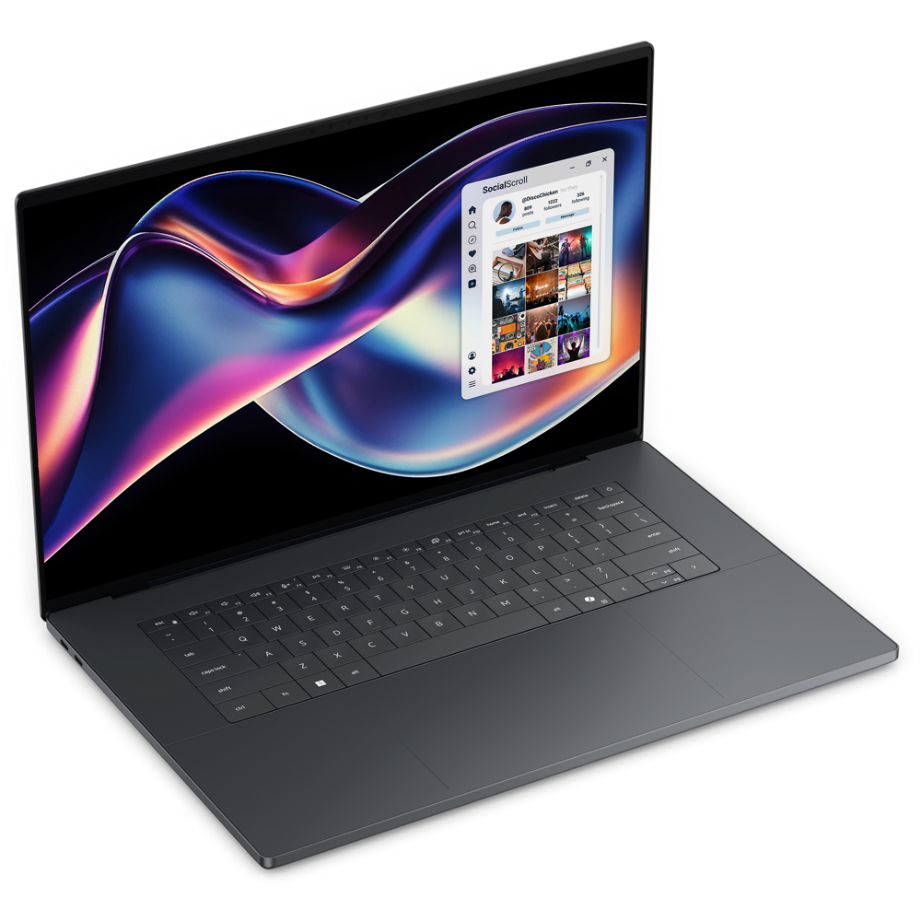
After a brief absence in 2025, Dell relaunched the XPS brand at CES 2026 to a very positive reception. The return of Dell’s high-end laptop line coincided with the release of Intel’s Core Ultra Series 3 processors, built on the Panther Lake architecture.
The XPS 16 we are evaluating in this Signal65 Lab Insights report is a premium 16-inch consumer laptop built around a 3.2K OLED touch display, a thin and light chassis, Thunderbolt 4 connectivity, and the Intel Core Ultra X7 358H with 16 cores, Arc B390 graphics, and an integrated NPU. Dell selected the most capable components that fit in a 16-inch thin-and-light design. The system we tested has 32 GB of memory and a 1 TB SSD, weighs 3.65 lb (1.65 kg), and measures 14.62 mm (0.58 in) at its thickest point, which makes it a very portable 16-inch machine.
Dell engineered the XPS 16 to run its processor at a lower power budget than the silicon allows, and it did so in exchange for battery life, efficiency, and a cooler, quieter chassis, which are the qualities people notice every day in a laptop they carry, making it even more premium. Peak processor wattage is one number on a specification sheet; the user experience is what this report attempts to measure. Signal65 tested the XPS 16 against a leading 16-inch competitor with the same processor, the same memory, and the same graphics, so differences in the results come from OEM and platform engineering rather than from the chip.
Key Findings:
The XPS 16 ran 13 hours 56 minutes in the Procyon Office productivity battery rundown, 47% longer than a leading 16-inch competitor built on the same Intel Core Ultra X7 358H, despite a 13% smaller battery.
The XPS 16 delivered more runtime from every watt-hour in all three battery scenarios we ran, 69% more in Office productivity, 25% more in video playback, and 4% more in web browsing.
Unplugged and in the default Balanced mode, the XPS 16 lost less of its performance than the competitor in every productivity and web test, and was 10% faster in Procyon Office as a result.
Single-threaded and short-burst multi-core performance were identical between the two systems, so the battery life and efficiency were not bought with responsiveness.
In the Balanced mode the XPS 16 was the quieter laptop at idle, 18.7 dBA against 22.5 dBA, and under a sustained all-core load, 40.4 dBA against 45.4 dBA, while its keyboard deck ran 3.4 degrees Celsius cooler at the hottest point.
The competitor led in sustained all-core rendering and 3D graphics, where its higher power budget applies. Dell chose battery life, efficiency, and a cooler, quieter chassis over peak sustained throughput, and for a premium consumer laptop that is the right side of the trade.