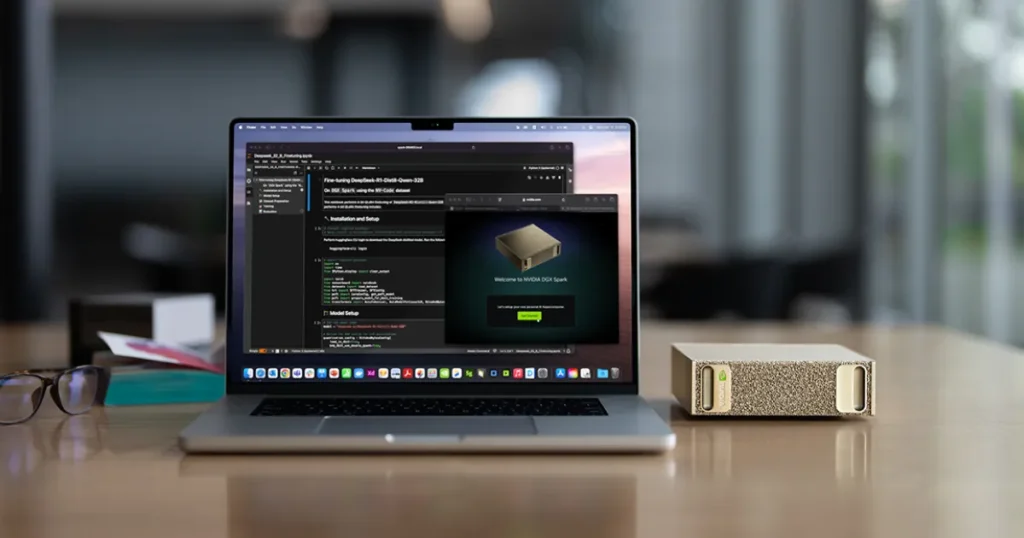
NVIDIA DGX Spark represents a meaningful inflection point in the personal workstation market. Originally introduced as part of the NVIDIA Project DIGITS initiative, DGX Spark is a compact, desktop-class AI supercomputer built around the GB10 Grace Blackwell chip, a co-designed processor from NVIDIA and MediaTek that pairs an Arm-based CPU complex with a full Blackwell GPU. Its stated purpose is to bring data-center-class AI capability to the desk of every developer, researcher, and engineer who needs serious local compute without a cloud invoice.
The GB10 CPU complex marks a significant differentiator: it is essentially the first Arm-based processor to enter the professional workstation class in a commercially shipping product targeting developer and engineering workflows. Built around ten Arm Cortex-X925 cores and ten Cortex-A725 cores, the GB10 CPU does not arrive as an experiment.
Instead, it shows up as a product positioned against established x86 workstations from HP, Dell, and others. The question the market is now asking is whether the Arm instruction set architecture, long dominant in mobile and now ascendant in hyperscale data centers, is ready to compete at the workstation level, where software optimization depth and raw throughput have historically favored x86.
The Signal65 evaluation situates the DGX Spark against two directly competing small form factor (SFF) workstations: the HP Z2 Mini G1a, powered by the Ryzen AI MAX+ Pro 395 from AMD (Strix Halo), and the HP Z2 Mini G1i, which pairs an Intel Core Ultra 7 265 with a discrete NVIDIA RTX 4000 SFF Ada GPU. These platforms represent the strongest x86 SFF competition currently available: one leveraging the high-bandwidth integrated GPU architecture from AMD, the other relying on a purpose-built discrete GPU.
Together they define a credible performance ceiling for the x86 SFF category, making them the appropriate reference points for assessing the DGX Spark competitive position.
Up to 41% faster CPU rendering vs x86 SFF workstations
Up to 50% higher memory bandwidth than competing x86 platforms
Up to 3.2x faster AI prompt processing than competing x86 workstations
Three narrative threads run through this paper. First, we examine whether the Arm + unified memory architecture of the GB10 delivers on its architectural promise across a broad range of traditional CPU workloads (rendering, compilation, scientific computing, and more) where x86 has decades of software optimization momentum.
Second, we quantify the practical impact of the DGX Spark and its 128GB unified memory pool, which enables local execution of models that are simply out of reach for competing platforms constrained by GPU VRAM.
Third, we assess the DGX Spark as a developer platform: not just a benchmark runner, but a viable daily-use machine for AI developers who want the full NVIDIA software ecosystem (vLLM, NeMo, CUDA) running locally on hardware that is architecturally continuous with NVIDIA cloud infrastructure.