Enterprise AI adoption is rapidly shifting from experimentation to execution, and increasingly, that execution is agentic. According to Futurum Research, 93% of enterprises are already researching, piloting, or deploying AI agents.
Early enterprise AI deployments have largely relied on cloud-hosted models due to their accessibility, scalability, and consumption-based pricing. While well suited for bursty workloads and specialized services, ongoing agentic AI workloads fundamentally change this economic model. Autonomous AI agents can operate continuously, generating sustained inference demand and significantly increasing long-term token consumption. Compared to standard chat interactions, agentic workloads consume orders of magnitude more tokens with agents easily utilizing 4x to 15x more tokens. As agentic workloads continue to evolve, token growth is expected to grow even further, with autonomous agents driving up to 1000x more inference demand than reasoning AI.
Dell AI Factory with NVIDIA infrastructure provides an alternative to cloud APIs, enabling organizations to run agentic workloads of all sizes on-premises, without per-token pricing. The Dell AI Factory with NVIDIA portfolio ranges from PCs, to workstations, to enterprise grade PowerEdge servers, all capable of producing and consuming tokens to support concurrent agents.
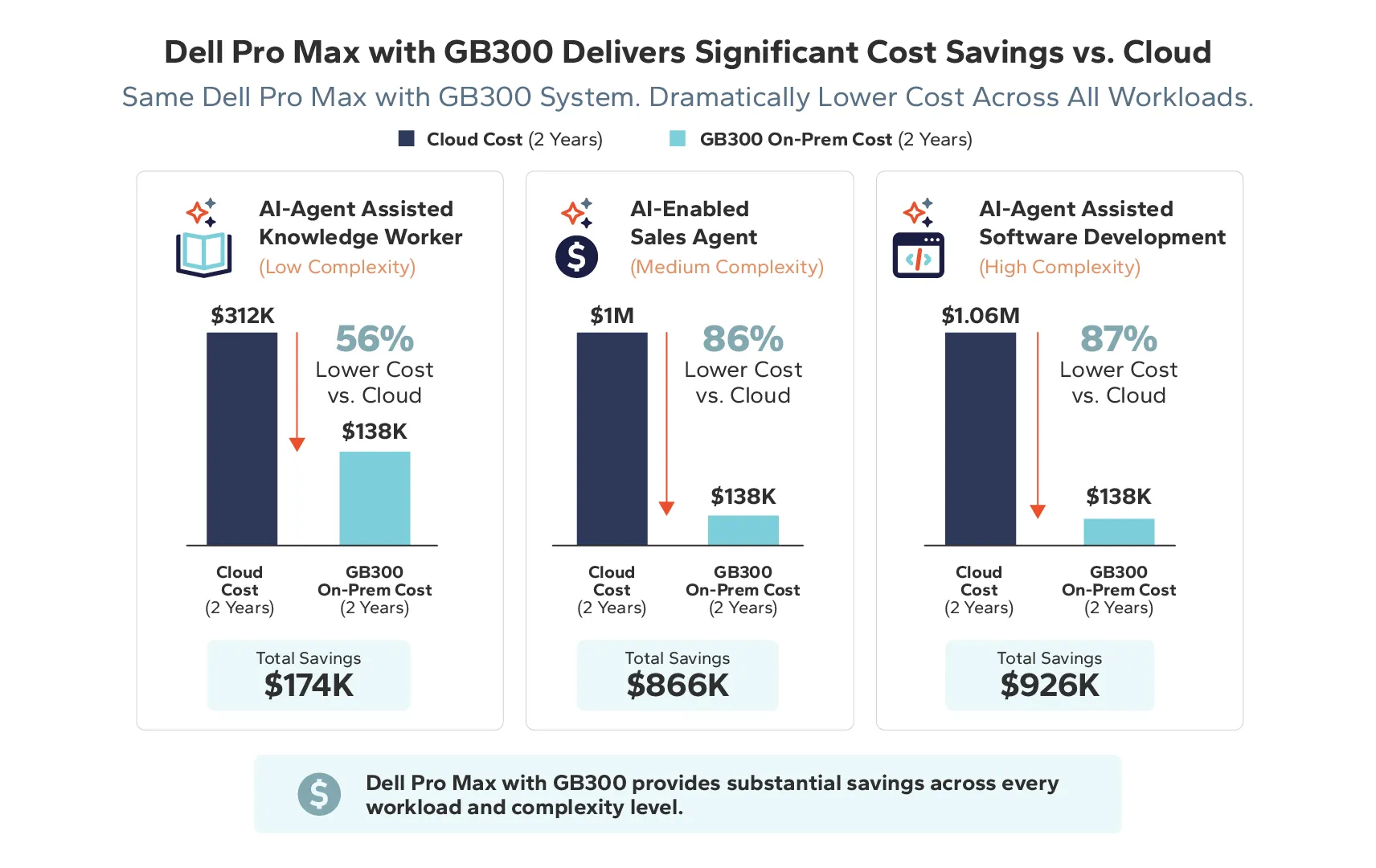
This analysis examines the economics of deploying agentic AI workloads on-premises with Dell AI Factory with NVIDIA infrastructure versus cloud-based APIs. Using Dell Technologies and NVIDIA performance and pricing data, the analysis models three enterprise workload profiles: an AI-agent assisted knowledge worker, an AI-enabled sales agent, and AI-agent assisted software development. Each workload was modeled as a persistent 24-hour deployment for 260 days a year—representing a global organization’s workweek—over a two year period. On-premises environments were configured with 60-80% utilization, depending on the workload, with cloud comparisons sized to match the number of agents supported by each hardware platform.
Across all tested profiles, on-premises AI infrastructure demonstrated a commanding financial lead, offering a substantial reduction in TCO (Total Cost of Ownership) compared to cloud deployments for both small-scale assistants and complex agentic fleets.