Enterprises increasingly rely on large language models to summarize reports, assist customers, and make data-driven recommendations; however, a core challenge remains trust. Without verifiable grounding in an enterprise’s data, LLMs can hallucinate, contradict policy, or expose compliance risk. Retrieval-Augmented Generation (RAG) emerged as the foundation for trustworthy AI at scale, linking generative models to proprietary knowledge sources through search, embeddings, and vector databases. As organizations deploy LLMs across regulated domains including finance, healthcare, engineering, the ability to retrieve the right information and reason over it accurately has become central to performance, governance, and brand integrity.
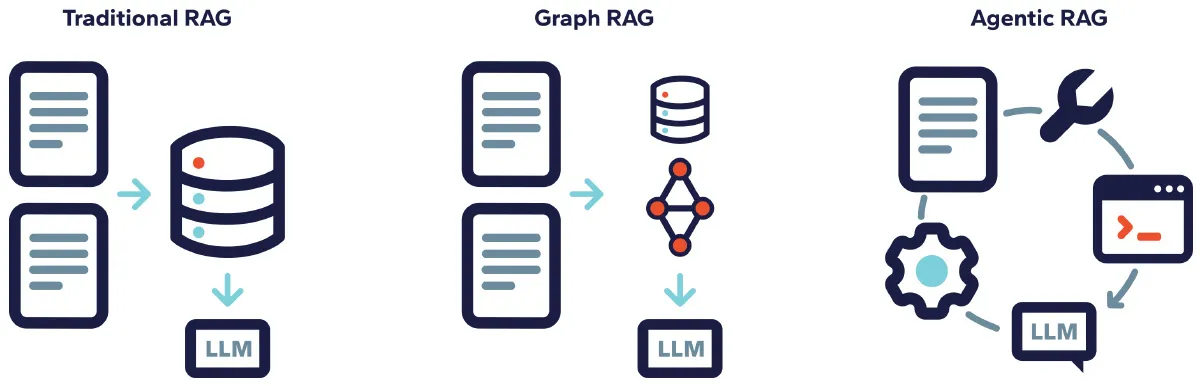
Classic RAG combines embeddings, retrieval, and generation in a single pass. It is simple, scalable, and effective for direct, single-hop questions but limited when the information needed spans multiple documents or relationships. Graph RAG extends this model by representing knowledge as an interconnected graph of entities and relations rather than isolated chunks. This structure enables cross-document reasoning and richer retrieval signals, linking products to suppliers, components to test results, or cases to policies. While Graph RAG improves accuracy and consistency, it introduces added complexity through graph construction and maintenance, requiring specialized indexing and continuing updates as knowledge evolves.
Agentic RAG represents retrieval that thinks. It introduces a planning-and-reflection loop with an agentic controller that decides what to retrieve, how to verify it, and when to iterate. Through self-grading and adaptive querying, Agentic RAG closes the loop between retrieval and generation, improving factual accuracy, interpretability, and task success on multi-hop and investigative workloads.